
Author: Diana Horelchanyk, CEO of Intent Solutions, 15+ years in digital marketing. Updated: November 10, 2026.
Comprehensive internet marketing is a set of digital marketing tools that work together to grow a business online. There are plenty of ways to promote a business, and each of them brings something. But finding the one channel that beats all the others by 1000%? That won't happen. What sells dresses brilliantly may be useless for a law firm or an equipment manufacturer. That's why we always recommend combining channels, and that's exactly what comprehensive internet marketing services are for.
In 2027, it's hard to do without. Search now talks to people in the voice of artificial intelligence, ad platforms do half the work on their own, and before buying, a customer manages to see you on Google, on Instagram and, quite possibly, in ChatGPT.
Comprehensive internet marketing tools
- SEO;
- GEO (optimization for AI search);
- Google Ads (PPC);
- SMM and paid social;
- SERM (online reputation management);
- email, SMS and messenger marketing;
- video marketing and YouTube;
- off-site content marketing.
Each of them works on its own. Together, they bring more traffic and, most importantly, more sales.
Channel comparison: what, when and why
A quick cheat sheet we usually show clients at the first meeting:
- SEO. Expect the first results in 3-12 months, but after that traffic keeps coming even when the work is paused. Best for a steady flow of customers from search.
- Google Ads: leads on launch day, but only while the budget lasts. For fast sales.
- Paid social: 1-2 days to launch. Great at creating demand, especially in B2C and for new products.
- SMM (managing your pages). A noticeable effect in two or three months. This is about awareness and trust, not instant sales.
- Email and messengers: repeat sales to people who have already bought from you.
- SERM. First changes in 1-3 months, and the effect lasts, because reviews don't go anywhere.
- Video: short clips can take off in a few days, while YouTube keeps collecting views for years.
- Off-site content. The effect builds up gradually: mentions, referral traffic, trust, plus support for SEO and GEO.
SEO: getting your website to the top
Search Engine Optimization is a set of work that makes your website better both for people and for search engines. Our goal is simple: promoting your website in Google and bringing in targeted traffic. In other words, getting the site as high as possible for the queries that matter.
Google wants to give people the most accurate answer. To do that, it uses algorithms that weigh hundreds of factors, and an SEO specialist tunes the site to those factors and, just as importantly, to real visitors.
Since May 2025, AI Overviews have been live in Ukraine: an answer Google generates right above the search results. Later, AI Mode, a conversational search format, became available to Ukrainian users too. Being the "first link" is no longer enough. You need AI to want to quote your page.
Key ranking factors
Content. Uniqueness and keywords haven't gone anywhere, but they're the bare minimum. Google has long been able to judge how useful the text and images are on category pages, product pages, blog posts and service pages. And it separately looks at whether real experience and expertise show through the text (the E-E-A-T principle).
A simple test for any page: does it answer all of the user's questions? Does it cover the topic fully? If the honest answer is "no", work on the content!
Technical optimization. A slow site, technical errors, broken layout on smartphones. With that combination, you're unlikely to reach the top, especially if there's any competition in your niche. Start with PageSpeed Insights (it shows Core Web Vitals) and Google Search Console, which collects indexing errors.
And if people land on your site but close the tab almost immediately, check your bounce rate. We covered the technical errors that drive it up in detail in our article "High Bounce Rate in Google Analytics: Possible Causes and What to Pay Attention To".
Off-site signals. These are links to your website from other resources that bring interested people to you. Referring sites vary in authority, and one link from a good industry portal is worth more than a dozen from random sites. For AI search there's one more detail: AI readily takes into account plain brand mentions in reviews, media and testimonials, even without a link. We'll cover backlinks (types, quality, where to get them) in a separate article.
User behavior. How long someone spent on the page, how many other pages they opened, whether they went back to the search results after three seconds. Google doesn't say outright which of these it counts. But if a person quickly runs back to the results, they probably didn't find their answer on your site.
When SEO is done right, search brings a steady flow of visitors, and leads come with it.
Pros and cons of SEO
Pros:
- the site becomes easier to use;
- it gets better technically, too;
- the cost doesn't depend on the number of visitors (with PPC you pay for every click);
- the results last.
Cons:
- not a fit for every business;
- it won't be fast.
*Optimization takes time, and then Google needs more time to index everything. Noticeable results usually show up in 3-12 months, depending on competition.
GEO: how to get into AI answers
It used to be all about one question: how do we get into Google's top 10? Now there's a second one: how do we get AI to mention us? People increasingly ask for advice not in the search bar, but in AI Overviews, ChatGPT, Gemini or Perplexity. If your brand isn't in the answer, the customer may never find out about you.
Optimizing for these answers is called GEO (Generative Engine Optimization). AI pulls information from indexed pages, so if a site struggles in regular search, it's unlikely to make it into an AI answer either. GEO doesn't work without solid SEO.
What helps you get into AI answers
- Open each section with a direct answer to the question, two or three sentences, and save the details for later. A chunk like that is the easiest thing for AI to "quote".
- A clear structure: headings, lists, an FAQ block.
- Specifics. Numbers, timelines, prices, real examples. A phrase like "we're the best on the market" means nothing to AI, it will just skip it.
- An author with a name, job title and experience, plus an update date. This works for both Google and AI systems.
- Schema.org markup for your organization, products, articles and reviews. It helps machines understand who you are and what you offer.
- Brand mentions beyond your site. Reviews, rankings, industry media, testimonials on Google Maps and platforms like Clutch. AI learns about you not only from your website, but also from what others write about you.
- And something basic that's often forgotten: robots.txt. If it blocks the search bots of AI services (for example, OAI-SearchBot, which ChatGPT search uses), you won't appear in their answers.
How to tell whether GEO is working
There's no convenient report like Search Console for regular search yet. But some things are visible. In Google Analytics 4, check traffic from chatgpt.com, perplexity.ai and gemini.google.com, and the newer GA4 reports even have a separate AI Assistant channel. For example, the medical center we describe below is already recommended by Google, ChatGPT and Perplexity, and dozens of new users come to its site from AI assistants. It's not a lot yet, but these visitors arrive "warm". And from time to time, simply ask AI the questions your customers ask ("which company should I choose for…", "what's better…") and see whether and how you're mentioned.
Google Ads (PPC advertising)
Search ads are shown to people exactly when they're looking for your product or service. Say you sell women's clothing. When setting up and launching Google Ads, we collect the queries your future customers type: "buy an evening dress", "buy a women's business suit" and so on. Your ads will be seen by people who are already about to buy.
Unobtrusive, convenient and fast. And in Ukraine, Google Ads still remains the most popular advertising platform, with plenty of tools for running campaigns.
Where Google Ads are shown
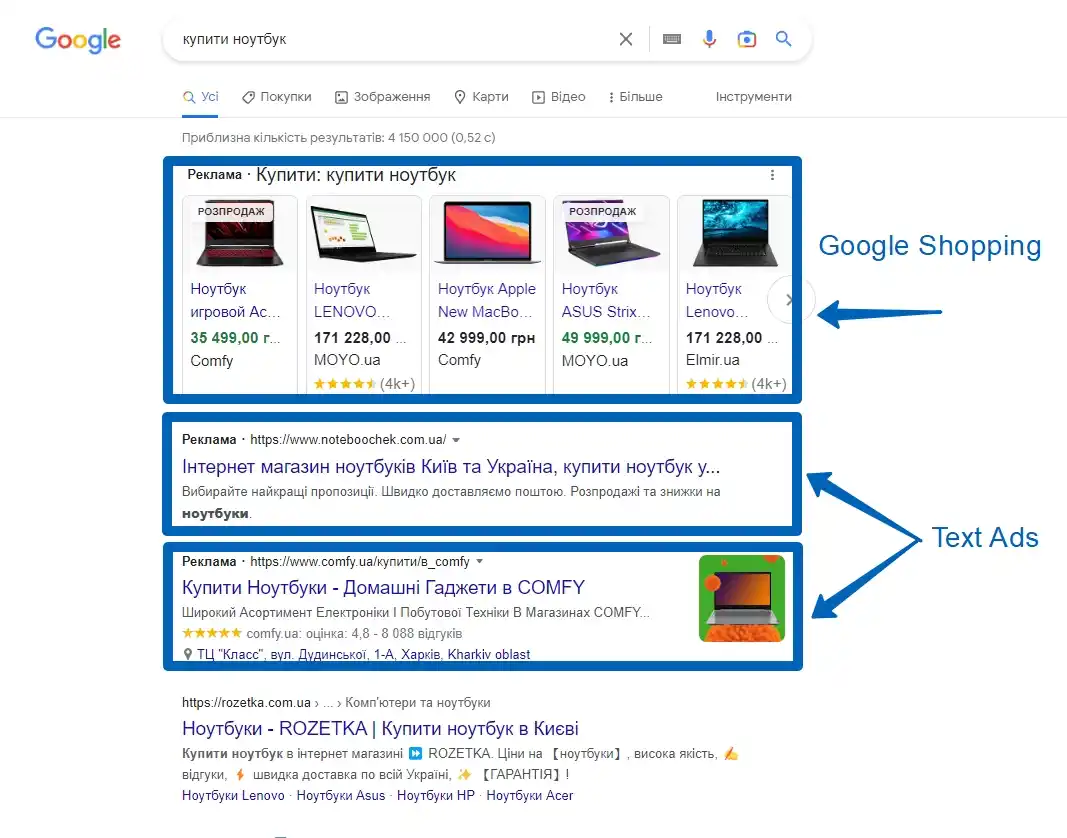
On the Search Network. Above and below the search results, labeled "Sponsored". They look almost like regular results and answer the person's exact query, which is why this format is usually the most effective.
Example of search ads in Google results:
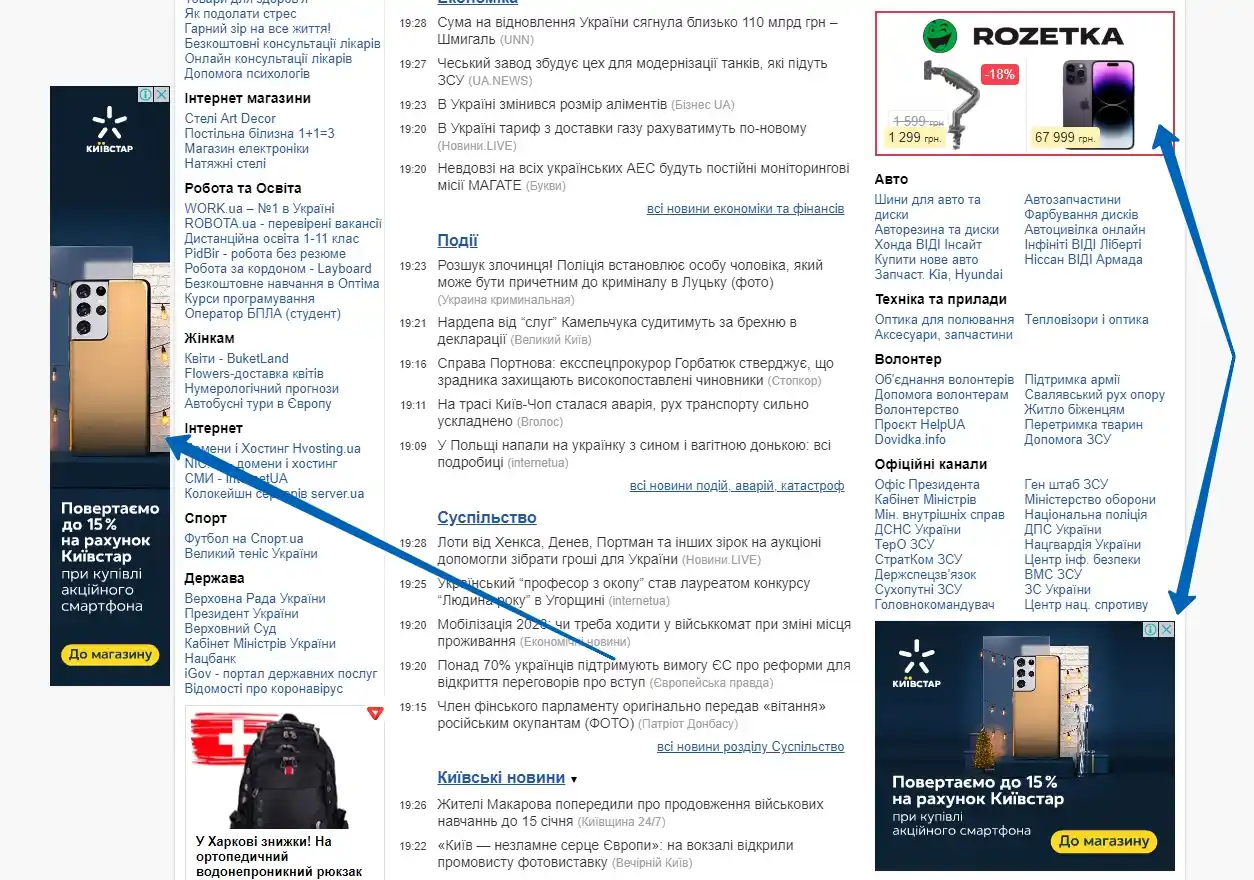
On the Display Network (GDN): banners on Google partner websites, in mobile apps and in Gmail.
Example of ads on the Display Network:
Google Shopping and Performance Max. For online stores, this is probably the most interesting part. Product ads with a photo and price right in the results, plus Performance Max campaigns that spread your ads across Search, YouTube, the Display Network and Gmail on their own. One condition: analytics and conversion tracking on the site must be set up correctly. Otherwise the algorithm optimizes blindly.
How Google Ads finds your audience
- by keywords, meaning specific search queries;
- by website topics: Google analyzes page content and places banners on related sites;
- by people's interests and intent;
- through remarketing, when ads "follow" people who have already visited your site but didn't buy anything.
Pros and cons of PPC advertising
Pros:
- fast: first clicks on launch day;
- you control the budget and can start small;
- statistics show where every hryvnia went;
- your ads are seen by your target audience.
Cons:
- just like SEO, it's not for everyone;
- you have to keep paying;
- set it up wrong, and the budget goes down the drain.
Combine SEO and PPC!
These are completely different tools, and there's no saying which one is better. SEO takes a long time to get going, but then works for years. PPC works right away, as long as you pay. When the budget ends, so does the traffic.
So why choose? While SEO gains momentum, PPC brings customers today. Once you reach the top, part of the ad budget can be moved elsewhere. There's a bonus too: ad reports show which queries actually end in a purchase, and that data goes straight into SEO. That's your two-in-one, and essentially the foundation of comprehensive internet marketing.
Case study: Doctor Alex medical center, Kharkiv
A large medical center came to us for SEO. But everyone understood: in medicine, SEO doesn't deliver fast results, and the clinic needed patients now. So at the start we launched Google Ads in parallel.
Healthcare in the region isn't the cheapest niche: a click in Kharkiv cost 7-10 UAH on average across all specialties. But the ads brought a flow of patients from day one while we worked on the website.
SEO started at roughly 250 visitors a day from search. After 6 months, organic traffic caught up with paid. After a year, it was more than double the ad traffic. Today the site gets an average of 900 visitors a day from search.
Separately, we optimized the site for AI search: page structure, direct answers to patients' questions, information about the doctors, schema markup, work with reviews. Today, for queries about medical services in Kharkiv, the clinic is recommended by Google's AI answers, ChatGPT and Perplexity. And a new source of patients has appeared in Google Analytics: the AI Assistant channel.
Now just do the math. If those 900 daily visitors had to be bought in Google Ads at 7-10 UAH per click, it would cost roughly 190,000-270,000 UAH a month. Even the growth alone (650 visitors a day above the initial 250) would cost 135,000-195,000 UAH every month. The client now gets this traffic without paying per click and uses ads selectively: for new services and seasonal offers.
In other words, the ads bought the business time, and SEO used that time to build a channel that now costs less than any advertising.
Social media marketing (SMM)
For a business, social media is a separate world of customers. There's competition, of course. But there's always demand, too. That's why we have a dedicated service: SMM (promoting products and services on social media).
For most brands, Instagram is still the main platform. TikTok delivers big organic reach, especially among younger audiences. Facebook holds on to an older audience. LinkedIn is for B2B.
Simply creating a brand page isn't enough: customers won't come on their own, let alone bring an explosion of sales. We explained how to grow a profile from scratch in our article "How to Gain Instagram Followers Organically and for Free in 2027".
There are many ways to attract customers through SMM. Let's focus on the most effective one: targeted advertising on social networks.
Paid social on Instagram, Facebook, TikTok and LinkedIn
Paid social helps you find your audience and bring it to your website or page. The ad manager is convenient: you can edit a campaign and check the stats while the ads are running, not just afterwards. The budget is flexible, and you can start small.
For B2B, take a look at LinkedIn. It's more expensive, yes. But it lets you target by job title, industry and company size.
It's important to understand the difference from search. On Google, customers are already "hot": they're looking for you themselves, and ads just help them find you faster and leave competitors no chance. On social media, it's the other way around: WE find the customer and let them know about us. But we do it nicely, so the person wants to buy even if a minute ago they weren't thinking about it.
SERM: online reputation management
Before buying, most people read reviews. On Google Maps, marketplaces, forums. And no amount of advertising will help if fresh negative reviews are sitting there without a reply.
SERM (Search Engine Reputation Management) means working with what people write about you. It includes:
- a complete, up-to-date company profile on Google (Google Business Profile);
- monitoring mentions and reviews;
- replying to negative feedback: calmly, to the point, offering to solve the problem;
- asking happy customers to leave a review. Obvious, but it works.
Reviews are no longer read only by people. When someone asks AI "which company should I choose", it relies on them too.
Email marketing, SMS and messengers
A good old method that still works. What email gives you:
- it reminds regular customers that you exist;
- it brings people to sales, discounts and new arrivals;
- it helps keep customers, for example by asking whether they were happy with everything.
In Ukraine, messengers have long joined email: Viber and Telegram broadcasts often get opened more readily than emails. And SMS works well for short messages like an order status or an appointment reminder.
Do you need email in comprehensive marketing? Yes, 100%. Just no spam. Write to people who agreed to receive your emails, segment your list, send things that are genuinely interesting. Don't be annoying.
There are tons of email services now, with ready-made templates and automation. If you're just starting out and don't know much about marketing yet, pick a service right away. You'll save loads of time.
Video marketing as a business growth tool
YouTube has a huge audience, and in format it's almost a social network. Setting up a channel is easy, the analytics are detailed, and videos show up in Google search. Then there are short formats: Shorts, Reels, TikTok. Their reach is sometimes bigger than any ad's.
To run YouTube ads through Google Ads, link your channel to your ad account. Then you can run your videos as ads and see full stats, all the way to conversions.
Off-site content marketing
This is when your company's content appears not only on your own website, but elsewhere too: on niche portals, in industry media, on social media. A blog on your site is a must, no question, especially if the articles are useful. But you shouldn't stop at your blog.
Why it matters
- more people hear about your brand;
- your target audience comes to you;
- SEO metrics grow;
- you get the mentions that AI search relies on;
- sometimes it's how you find partners, too.
What to publish
- useful articles where your brand is mentioned for a reason;
- case studies;
- pieces about your product and its advantages;
- anything that clearly shows why people should come to you.
As a bonus, you get referral traffic from other sites and reach people who had never heard of you before.
Internet marketing trends for 2027: what to watch
Some of what worked well two or three years ago no longer delivers the same results. Here's what we recommend keeping an eye on when planning for 2027:
1. Search is becoming AI search
For simple queries, people now often get the answer right in the results and don't click anywhere. Traffic from those queries is shrinking. But those who do click through want details, and they're usually higher-quality visitors. That's why SEO for 2027 should be planned together with GEO from the start (we covered it above).
2. Google Ads is becoming even more automated
In 2026, AI Max came out of beta and became the default setting for new Search campaigns. Starting in February 2027, Google is automatically moving classic Dynamic Search Ads (DSA) to AI Max. And ads in AI Overviews and AI Mode are only available to campaigns using AI Max or broad match, Shopping and Performance Max.
In practice, the specialist spends less time "turning knobs" and is more responsible for the data the algorithm receives. Proper conversions, negative keywords, solid ads and landing pages. Without that, automation will quickly learn to spend money on junk queries.
3. ChatGPT ads are now available in Ukraine
OpenAI has opened ChatGPT advertising to Ukrainian advertisers: you can launch a campaign yourself through Ads Manager or through partners. The ads are shown to users of the free version and the Go plan. It's a new channel, so start with a small test budget.
4. Short-form video is holding its ground
Reels, Shorts and TikTok are still one of the cheapest ways to get reach. And what works best isn't glossy production, but real videos: the team, the work process, answers to customers' questions.
5. Analytics is becoming a must
The more automated advertising becomes, the more it depends on the data you feed it. Google Analytics 4, conversion tracking, Consent Mode, CRM integration. It used to be "nice to have", but now without it you simply can't tell what sells and what eats your budget.
6. Trust matters more than ever
Reviews, case studies, real people from the team, real numbers. There's more generated content every month, and anything real stands out against it.
How we build a comprehensive strategy
Comprehensive marketing doesn't mean "launch everything at once". Here's how we usually go about it:
- Audit: the website, analytics, current ads, competitors.
- Goals in numbers. How many leads or sales you need, and how much you can pay per customer.
- Foundation: we fix critical technical errors on the site and set up analytics.
- Fast channels. Google Ads and/or paid social, to get the first sales and the first data.
- In parallel, we start the long-term ones: SEO, content, reputation management.
- Every month, we look at what actually sells and move the budget there.
FAQ
Where should I start with comprehensive internet marketing if my budget is limited?
With the foundation: a user-friendly website, analytics set up, a complete Google Business Profile. Then one or two channels that bring customers the fastest, usually Google Ads or paid social. Once they start paying off, add SEO and the rest.
How much does comprehensive promotion cost?
It depends on the niche, region and set of channels, so we give an exact figure after analyzing the project. As a guide: SEO from $500 a month, Google Ads management from $300 on average, paid social setup and management from $400. The ad budget for Google Ads and social media is paid separately.
When can I expect the first results?
From ads, almost immediately: the first leads can come in on launch day. SEO is slower: usually 3-12 months, depending on competition. That's exactly why we recommend running them together.
What should I start with: SEO or Google Ads?
Need sales right now? Google Ads. Planning to stay in the market for the long haul and don't want to depend entirely on an ad budget? Add SEO in parallel. Ideally, both, just with different weight at the start.
Do I need SMM if my business is B2B?
Yes, but a different kind. In B2B, what matters most is LinkedIn, expert content, case studies and the personal brand of company leaders. Instagram and TikTok are more for awareness here than for leads.
How do I know which channel actually brings sales?
Set up analytics: Google Analytics 4 with conversions, UTM tags on all ad links, and ideally CRM integration too. Then you see not just clicks, but specific orders from each channel.
Can I run some channels myself?
Yes, and many people do: they handle social media or email themselves and hand ads and SEO to an agency. The main thing is that everything follows one strategy and you see the overall picture, not numbers from five different dashboards.
Comprehensive internet marketing: the bottom line
A comprehensive approach lets you combine several tools instead of squeezing everything out of one. PPC and paid social give you a fast start. SEO and content work for years ahead. Email and reputation keep the customers you already have. And you manage the budget yourself, moving it to wherever it works best.
Just remember: all this traffic leads to your website. So if you're only planning to launch, start with website development for your business.
Intent Solutions can take care of everything: from website development and ad launches to optimization and business process automation. Learn more about our comprehensive internet marketing services.
About the author
Diana Horelchanyk is the CEO of Intent Solutions, with 15+ years of experience in digital marketing. Since 2013, the company has been building websites and mobile apps and doing digital marketing for businesses: SEO, Google Ads, SMM, and now AI search optimization as well. LinkedIn profile.